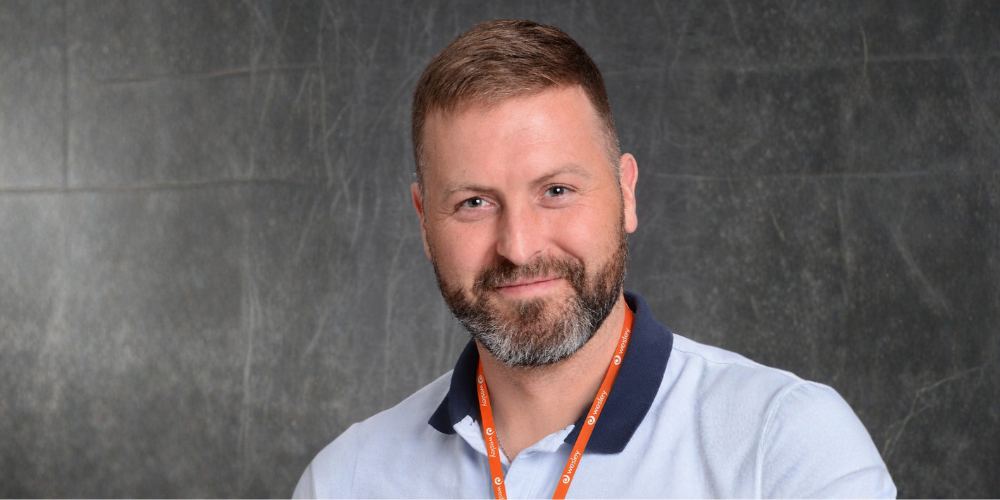
For Thomas, an Intensive Case Manager in Wesley’s Housing Program in Hamilton, helping people find housing means more than providing a roof over their heads. It means giving people the stability and security they need to regain their independence and look toward the future.
Thomas joined Wesley in August 2025, bringing several years of experience in social services. His path to this work began in the culinary field, but after recognizing a desire for a different kind of career, he returned to school to pursue social services. Motivated in part by his own experiences and those of people close to him, he went on to work in employment services for youth facing barriers, at a housing resource center, and at a local shelter.
After moving to Hamilton, Thomas wanted to find a way to make a difference in his own community. Joining Wesley gave him the opportunity to do just that.
“I thought it was preferable to work in the community in which I lived,” he explains. “I couldn’t be more pleased with the way things turned out.”
Through his education and work, Thomas developed a deeper understanding of the many circumstances that can lead to homelessness. Today, he draws on that experience to support people navigating the challenges of finding and maintaining housing. His role involves connecting with people living in shelters and encampments, helping clients establish an income and obtain identification, and finding housing that meets their financial circumstances.
But finding housing is only the beginning. Through Wesley’s Housing Program, clients can continue receiving support for up to two years after being housed, helping them navigate the challenges of maintaining a home and building a more stable future.
As an Intensive Case Manager, Thomas also works with clients to address everything from landlord-tenant issues to unexpected changes in their personal lives. He also helps them identify and navigate the resources available to them and develop the life skills they need to maintain their housing and work toward greater independence.
He notes that it is important to note that meaningful progress doesn’t always show up in statistics we read because often the reporting that needs to be done focuses on straightforward numbers like how many people were housed, while leaving out how many then returned to homelessness. Finding housing is only the first step; people who have experienced homelessness for years may also need support in developing life skills and routines to maintain a home.
Thomas has worked with clients who spent decades homeless and whose experience of daily life differs greatly from someone who has always had stable housing. As he explains, “You can put someone between four walls. It doesn’t mean they know how to live in a healthy, sustainable way.”
Helping clients build these skills takes time but is essential to prevent a return to homelessness. Without that ongoing support, Thomas points out, housing programs risk creating “a revolving door of homelessness.”
Despite the many steps involved in the process, positive outcomes make all of the hard work worth it. Thomas says one of the most fulfilling parts of his job is seeing clients finally relax once they have a home of their own.
When someone has been living outside or in a shelter, there is often a constant need to stay alert and protect their belongings. Even after moving into a home, it can take time to trust that their housing is secure. Thomas sees the difference as uncertainty begins to fade.
“Their need to be constantly in survival mode kind of dissipates,” he says. “They can start to begin really living life.”
One of the most important lessons Thomas has learned through his work is how easily someone can become homeless, often through circumstances beyond their control. Financial hardship, rising housing costs, health challenges, and unexpected changes in living arrangements can leave people without a home, even after years of working and supporting themselves.
Thomas recalls working with a 61-year-old man who had spent most of his life working before developing a degenerative medical condition that meant he had to rely on disability benefits. When his landlord needed the rental home for their child to move into, he lost his housing and struggled to find an affordable alternative.
With nowhere else to go, he began living in the woods, where he felt safer than he would in the downtown core. Even through the winter, he slept in a tent with his two dogs.
With support from Thomas and Wesley’s Housing Program, he eventually secured a home and began rebuilding his life. Today, his home is immaculately clean, and Thomas says he is thriving. With greater stability, he has also been able to reconnect with family and build new relationships.
His story also highlights how difficult it can be to remain financially secure even after finding housing. For people living on disability benefits, rent can still consume a significant portion of their income, leaving little room for other necessities. And homelessness is not confined to a city’s downtown areas. Thomas has worked with clients living in wooded areas and even in cornfields. For some, particularly older men who feel vulnerable downtown, these isolated places offer a sense of safety.
Though he’s been studying the subject for so long, Thomas says that experiences like these have reinforced that homelessness cannot be understood through assumptions about someone’s choices. There are almost always complex circumstances behind how a person loses their home, leaving them with very few, if any, options for finding accommodation.
“It could be your family member. It could be the person you see at Tim Hortons in the morning,” he says.
For Thomas, helping someone find a home is about more than addressing their immediate housing needs. It is about creating the stability that allows them to move forward, even when other challenges remain. He recognizes that people’s circumstances are complex, and that lasting change takes time, support, and the opportunity to make choices for themselves.
He also emphasizes that housing and substance use can be closely connected in both directions. While substance use can contribute to housing loss, the stress and instability of homelessness can also make existing challenges more difficult. Having a secure home can help reduce those pressures and give people more room to make choices that support their well-being.
“It’s not about people being perfect,” Thomas explains. “It’s about allowing them to get to a point where they are having a more fulfilling existence and are capable of making those choices for themselves.”
One of the most interesting parts of working at Wesley, Thomas explains, is that no two days are the same. The role requires adaptability, an open mind, and a willingness to meet people where they are, without making assumptions about their circumstances or experiences.
He emphasizes the importance of communicating in ways that feel natural and comfortable to the people being supported, rather than relying on professional jargon. Building genuine connections means taking the time to understand each person’s unique story and recognizing that everyone brings their own experiences, challenges, and perspectives.
While the work can be challenging, Thomas finds it rewarding to connect with people from different walks of life and gain a deeper understanding of the human experience. He also appreciates the supportive work environment at Wesley, where colleagues are willing to share their knowledge, offer guidance, and help one another navigate unfamiliar situations.
His advice to anyone considering a career at Wesley is to approach people with an open mind, stay curious, and never be afraid to ask questions. Those who are new to the field can expect to keep learning on the job, with a team ready to help them grow in their role.
“No one is expecting you to know everything from the start,” Thomas says. “It’s once you’re hired that the real learning begins.”
In closing, Thomas shares this final thought: “If you are someone who is interested in or passionate about being involved in your community and trying to better your community, there are many opportunities for you to do that here at Wesley.”
Want to do work that matters? Explore career opportunities at Wesley and discover how you can help strengthen our community.